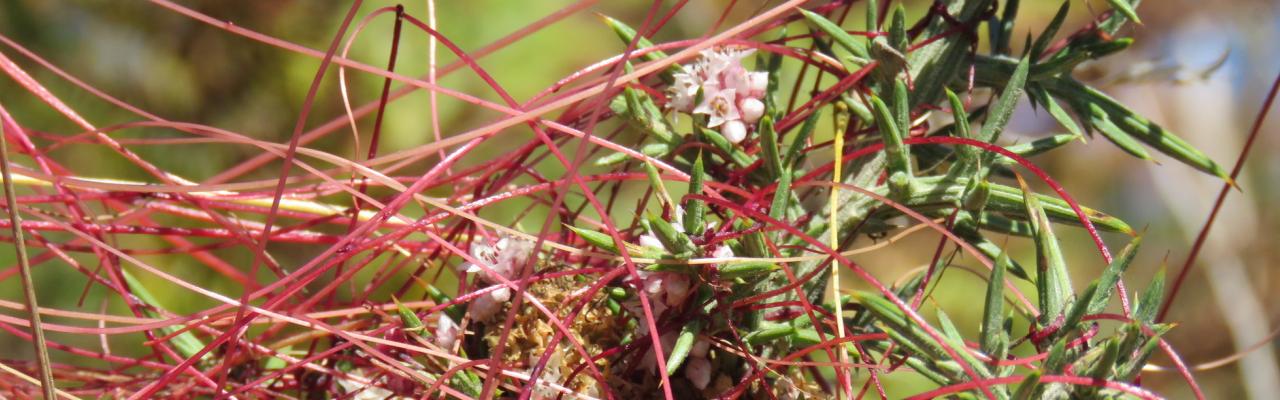
Dodder (Cuscuta Epithymum)
June’s species of the month is Dodder (Cuscuta epithymum), a small parasitic plant that contains no chlorophyll. Also referred to as Hellweed, this leafless annual vine forms a red stringy mass over its host plant, with small pink and white flowers appearing in summer. Stems from a single dodder plant have been reported to reach over 0.5 miles in length, if the host is large enough.
Dodder is an obligate parasite, meaning they cannot complete their life cycle without exploiting a suitable host. The seed of dodder contains minimal nutrients, so the shoots must find a host plant quickly. Once the shoot finds a host plant it twists around its stem in a counterclockwise motion, tightening and sending out haustoria (sucking roots) that pierce through the epidermis and into the xylem. This allows them to draw nutrients and water from the host plant. Some stems remain loose to search for other hosts.
Dodder can often be seen parasitising on Thyme, Gorse, or Birds-foot Trefoil across Alderneys dune grasslands. Despite this, there are currently very few records of Dodder in Alderney, so if you do see some let us know!